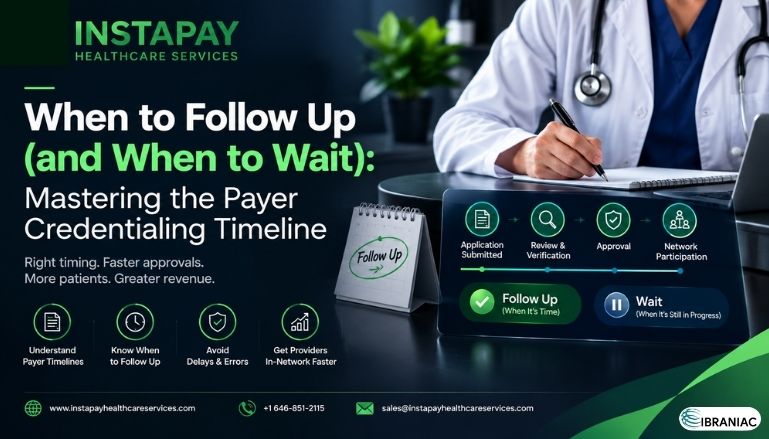
When to Follow Up (and When to Wait): Mastering the Payer Credentialing Timeline
Starting a solo practice is exciting. You have your space, your first few clients, and a clear vision for patient care. But then comes the hard stop: payer credentialing. This essential administrative hurdle is often shrouded in mystery, leaving many a solo provider frustrated and wondering: "Am I doing this right?" and more importantly, "When should I call them?"
At Instapay Healthcare Services, we know that waiting for approval feels like watching paint dry, especially when your revenue is on the line. The key to maintaining your sanity and accelerating your process is mastering the payer credentialing timeline. Knowing when to engage in targeted insurance follow-up and when to simply wait is the difference between a smooth process and administrative burnout.
Understanding the Credentialing Black Box
First, let's set realistic expectations. The overall payer credentialing timeline can range dramatically, usually between 90 and 150 days from the date a complete application is received. Many providers assume the moment they hit "submit" on their CAQH application or mail their paperwork, the clock starts ticking quickly. In reality, the process moves through several distinct stages, and your solo provider application will spend significant time in each:
- 1. Initial Submission & Intake (1-4 Weeks): The payer receives your application and assigns it to a representative. This is when many applications are rejected for simple errors.
- 2. Verification & Primary Source Verification (4-8 Weeks): The bulk of the time is spent here. Payers verify all your documents (licenses, education, certifications, malpractice) with the original source.
- 3. Committee Review (2-4 Weeks): A medical review committee meets to officially approve the provider.
- 4. Contracting & Loading (2-4 Weeks): The contract is finalized, and your details (including your effective date) are loaded into the payer's system, allowing you to bill.
When to Follow Up: The Proactive, Targeted Approach
Aggressive, daily calls will not speed up the process and often just irritate the payer staff. Effective insurance follow-up is strategic and reserved for specific milestones.Follow Up Immediately (Within 2 Weeks of Submission): The first follow-up is critical. Call to confirm that the payer has received your application and that it was deemed complete. If it's incomplete, you risk rejection and starting the whole payer credentialing timeline over. Confirm the name of the assigned analyst or representative.
Follow Up Mid-Process (Every 4 Weeks): The verification stage is long. If you haven't heard anything in 3 to 4 weeks, a brief, polite check-in is appropriate. Ask where they are in the Primary Source Verification process. Crucially, if you are a solo provider and you know a certain verification source (like a university or prior employer) is slow to respond, let the payer know you are actively chasing that source yourself to speed up their verification step. This shows you are engaged and proactive.
Follow Up Post-Committee (Immediately After the Expected Approval Date): Once the committee approves you, the final step is data loading. This is where many successful applications stall. Engage in persistent insurance follow-up during this final phase to confirm your effective date and ensure your billing data is accurately entered into their system. This guarantees that your first claims won't be denied due to a "provider not on file" error.
When to Wait: Knowing the Administrative Cycle
The vast majority of the payer credentialing process is machine-driven and cyclical. The payer cannot fast-track verification steps like committee review or state license checks.
Do NOT Follow Up Daily or Weekly: This creates administrative noise and doesn't accelerate the system. Do NOT Follow Up During Committee Review: This is a fixed, internal meeting process. Your call cannot change the date or outcome. Do NOT Follow Up Before the Stated Timeframes: If the payer tells you the verification takes 45 days, calling on day 15 will only lead to frustration. Trust the process during the long, middle phase.
By understanding the realistic payer credentialing timeline and deploying strategic insurance follow-up, your solo provider practice can move from application to reimbursement with maximum efficiency and minimal anxiety.
Ready to take the guesswork out of the credentialing process? Instapay Healthcare Services specializes in getting solo providers paneled efficiently.